What is the AI Gateway?
The AI Gateway is an integrated platform designed to manage the full lifecycle of AI Gateways and the AI traffic that flows through them — including LLM provider calls, Model Context Protocol (MCP) exchanges, and AI agent workflows — across enterprise Kubernetes environments. It provides a centralized set of tools for creating, modifying, securing, deploying, and monitoring gateways across multiple clusters and projects. Rather than being a generic API gateway with AI features bolted on, this platform is built on top of agentgateway — an AI-first proxy with native support for OpenAI-compatible endpoints, MCP servers, and agent-to-agent (A2A) communication, deployed as a Rust data plane orchestrated by a Go control plane.
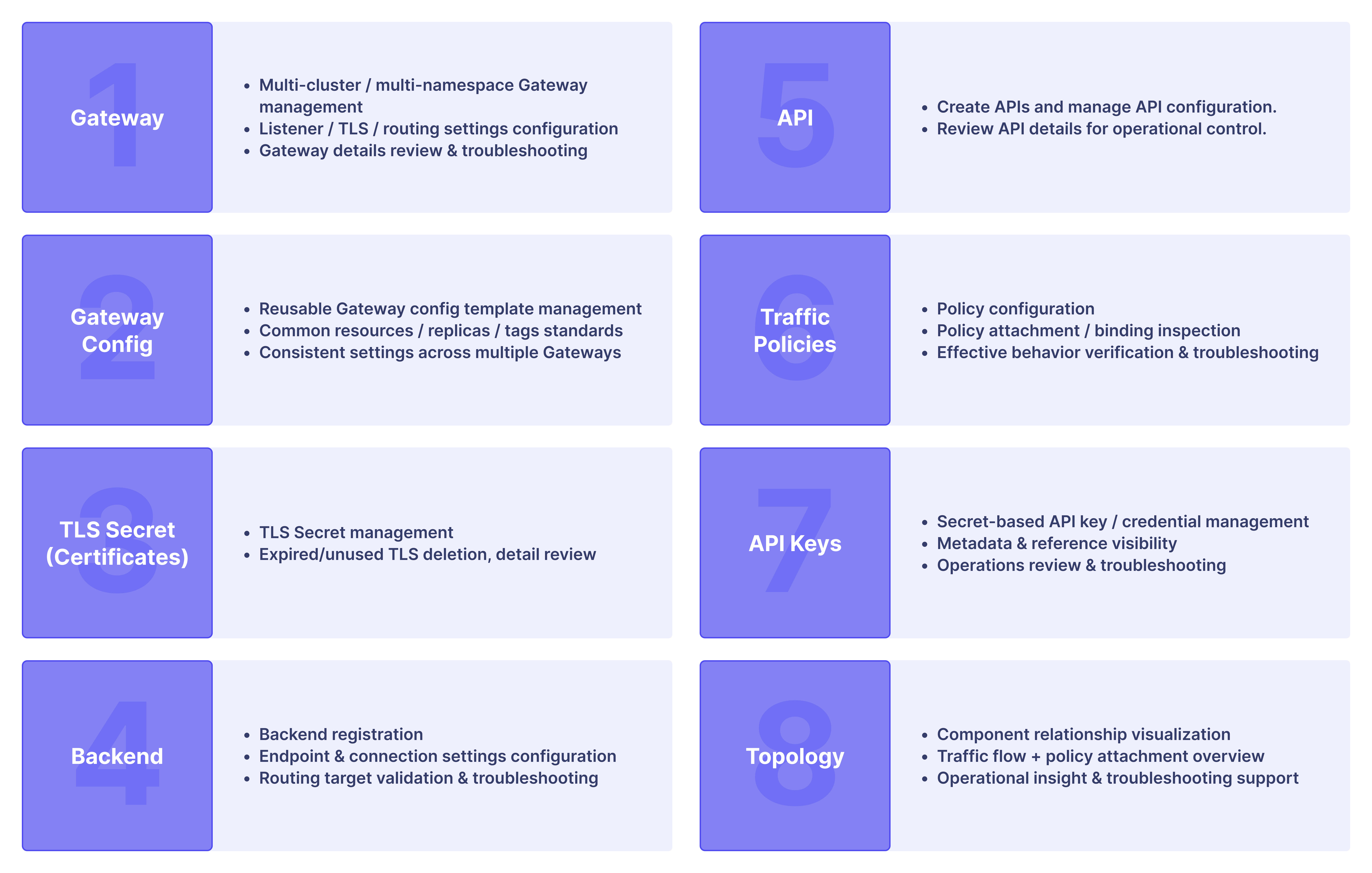
Key components and capabilities include:
- Gateway Lifecycle Management: Create, configure, version, and deploy agentgateway instances with full control over listeners (host / port / protocol), TLS termination, infrastructure parameters (image, CPU / memory, replicas, HPA, PDB, logging), and listener exposure modes (direct LoadBalancer or ingress mode) across multiple Kubernetes clusters.
- Multi-Backend Support: Manage multiple backend types through a single AgentgatewayBackend resource: ai (LLM providers such as OpenAI, Anthropic, Bedrock, Azure OpenAI, Gemini, Vertex AI), mcp (Model Context Protocol servers via SSE / StreamableHTTP), static (REST endpoints and K8s Services), and dynamicForwardProxy (destination resolved from the Host header at runtime).
- Project-Based Isolation: Each project serves as an independent unit with its own gateways, backends, routes, policies, and secrets, scoped under a centralized realm. Cluster, namespace, and project context are enforced at the API layer, enabling secure multi-tenant operation while preserving cross-project visibility for platform administrators.
- AI Policy Management: Apply centralized policies for authentication (JWT, API Key, CEL-based authorization), rate limiting, prompt guarding (request and response inspection), response caching, transformations, retries, timeouts, header modifications, and AI-specific guardrails — all attachable at Gateway, HTTPRoute, or Backend level via a unified AgentgatewayPolicy CRD.
- AI Provider Failover & Load Balancing: Configure multi-provider routing inside backend.ai using priority + weight groups for automatic failover (e.g., OpenAI primary → Anthropic fallback) and weighted load balancing within the same priority tier. Supports model-name-based routing, where the gateway inspects the model field in the request body and dispatches to the matching backend — enabling a single OpenAI-compatible endpoint to serve many providers transparently.
- Topology Visualization: An auto-rendered interactive graph (Vue Flow + Dagre) showing Gateway ↔ HTTPRoute ↔ Backend ↔ Policy relationships with click-through detail panels, helping operators trace how a request flows end-to-end and understand the impact of any configuration change.
- Logging and Monitoring: Inspect per-request audit events (/events endpoint per API), track per-project / per-model usage, and surface latency and error metrics through built-in monitoring dashboards — giving operators visibility into both the configuration plane (who changed what) and the runtime plane (what traffic is flowing where).
The Purpose of AI Gateway
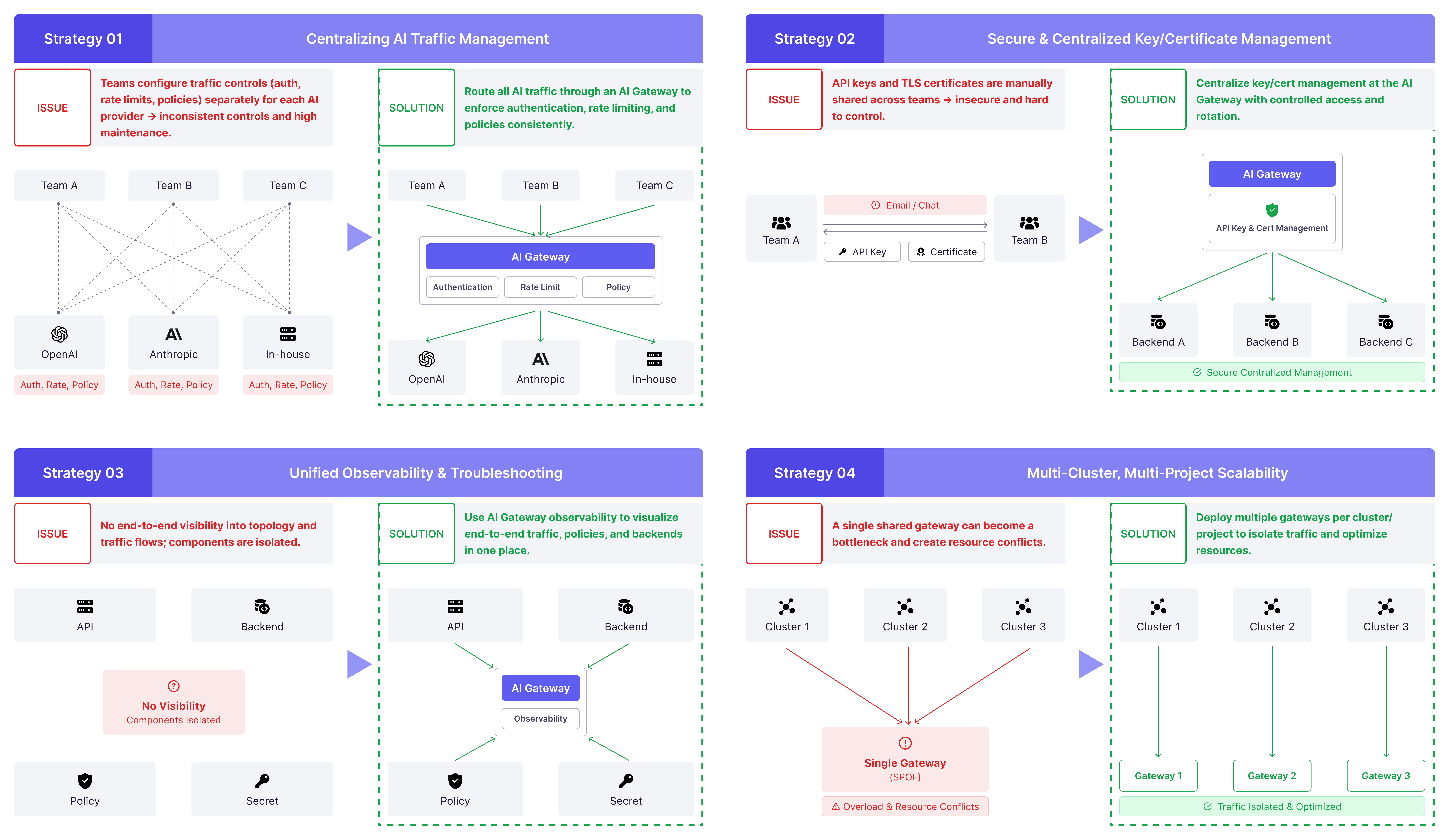
As enterprises increasingly adopt AI-driven services, the volume and complexity of AI traffic have grown dramatically. Requests now span multiple AI patterns—LLM provider calls, MCP exchanges, and agent workflows—and run across many Kubernetes clusters and projects. This creates significant operational, security, and governance challenges:
- Teams must manage gateways across clusters with consistent configuration (listeners, TLS, scaling, logging, deployment settings), which is difficult to standardize and error-prone when done per team or per environment.
- The growing number of backend types and providers (OpenAI-compatible LLMs, MCP servers, internal REST services, dynamic forward proxy destinations) makes routing and endpoint management increasingly fragmented.
- Multi-tenant operation across projects requires strong isolation (separate gateways, routes, policies, and secrets per project) while still enabling platform administrators to maintain cross-project visibility and control.
- Without centralized policy management, controls such as authentication (JWT/API key/CEL authorization), rate limiting, prompt guarding, caching, transformations, retries, and timeouts are implemented inconsistently, leading to gaps in security and unpredictable service behavior.
- Provider reliability and cost management become harder as usage grows; enterprises need built-in failover and weighted load balancing across multiple AI providers, including model-based routing behind a single OpenAI-compatible endpoint.
- Lack of unified observability—request audit events, usage by project/model, latency/error metrics—and poor topology visibility makes it difficult to understand traffic flows end-to-end, assess the impact of changes, and troubleshoot quickly.
These challenges highlight the need for a unified, AI-native gateway platform that standardizes how AI traffic is secured, routed, governed, and observed across the enterprise. AI Gateway addresses this by providing centralized lifecycle management for agentgateway deployments, consistent policy enforcement at multiple attachment points (Gateway/Route/Backend), flexible multi-backend routing with failover, and clear topology plus monitoring—enabling teams to move fast while staying within enterprise security and operational standards.
Key Benefits
The AI Gateway system enhances both the reliability of AI services and operational efficiency. Its key benefits include:
- Unified AI Traffic Management: Provides end-to-end management of all AI traffic through a single platform, simplifying routing, authentication, and policy enforcement.
- Scalability & Flexibility: Supports multi-cluster and multi-project environments, enabling service isolation, team autonomy, and seamless integration with both internal and external AI service providers.
- Centralized Policy Governance: Enforces policies consistently across the enterprise, reducing risks of misconfiguration and ensuring compliance across the enterprise.
- Enhanced Security: Manages certificate and API key lifecycles to minimize manual errors and security risks.
- Operational Efficiency: Provides visualization, reusable templates, and bulk management tools to reduce overhead and accelerate troubleshooting.
- Consistent Observability: Provides visual topology, traffic flow, and status of all components, enabling quick troubleshooting and operational transparency.
In short, the AI Gateway system empowers organizations to manage AI traffic securely, efficiently, and transparently, supporting both innovation and compliance in a modern AI-driven enterprise.